Most resume tools optimize for keyword count or generic prose. Employers use a layered process: document parsing, retrieval, ranking, semantic review, and human judgment. Improving one layer while damaging another produces a worse application.
← Portfolio overview04 / 04
Employer-side performance
Resume Screening Optimizer
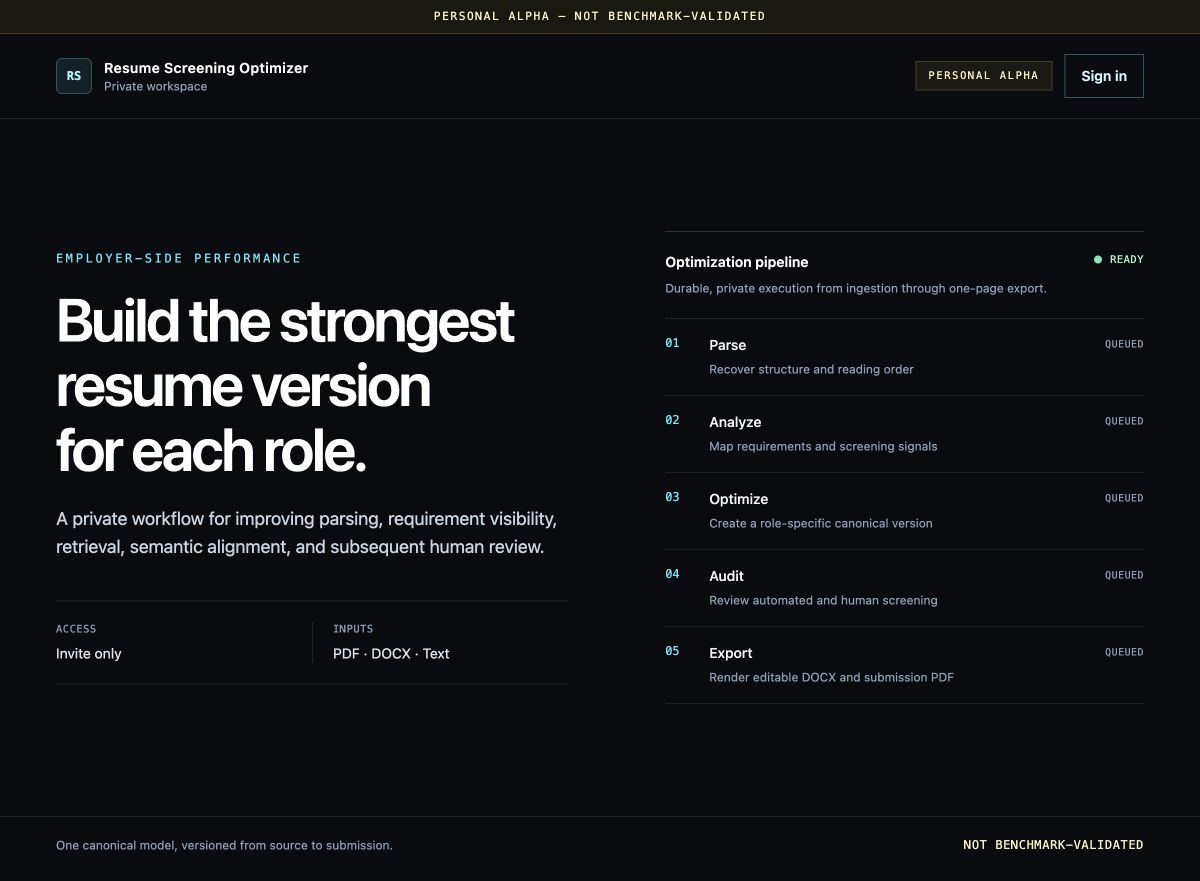
Build the strongest truthful resume version for each role.
A private, durable workflow that improves parsing, requirement visibility, retrieval, semantic alignment, human review, and one-page document export.
- Role
- Product architect and full-stack engineer
- Year
- 2026
5Durable workflow stages
550+Automated tests
2Verified export formats
The brief
The optimizer versions a canonical resume from source to submission, maps job requirements to grounded evidence, routes the draft through automated and human-review perspectives, and compacts the result into editable DOCX and submission PDF outputs.
The production workflow completes end to end, preserves truthful employer and project identities, contextualizes requirements instead of appending awkward keywords, and enforces one-page rendering with independent review gates.
System map
From ambiguity to evidence.
- 01Parse
- 02Analyze
- 03Optimize
- 04Audit
- 05Export
Research foundation
Optimize for the actual employer workflow.
The product is grounded in employer-side ATS and AI-screening research: recover the document correctly, make evidence retrievable, align relevant language, and preserve clarity for the person who reads the shortlist.
Durable execution
One canonical model, versioned at every stage.
Parsing, analysis, optimization, review, and export run as a recoverable workflow. Each version can be traced to its source rather than becoming an unstructured pile of generated files.
Document quality
The output has to survive Word and PDF.
The renderer validates physical page geometry, typography, spacing, and section order in both formats. Dense layouts are tested against emitted document structure, not assumed from a single preview.