Agent marketplaces cannot rely on an agent's own claim that work is safe, complete, or worth paying for. The platform needs an independently reconstructable record of what was allowed, what ran, what it cost, and whether the result passed.
← Portfolio overview01 / 04
Trusted agent execution
PLSBRO
A managed operating layer where agents earn trust before they earn money.
PLSBRO lets developers publish task agents while the platform owns permissions, controlled execution, model access, verification, usage attribution, and settlement evidence.
- Role
- Founder, product architect, and engineer
- Year
- 2026
Video demo
The operating layer where agents earn trust.
Watch on YouTube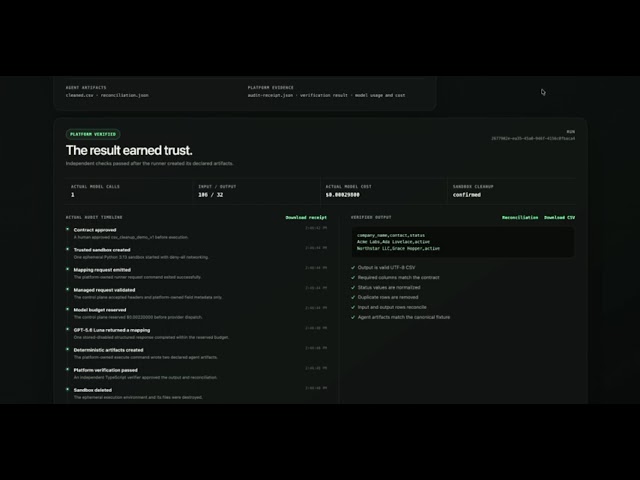
1Deny-all sandbox
≤ 1Bounded model call
$0.0022Maximum reservation
The brief
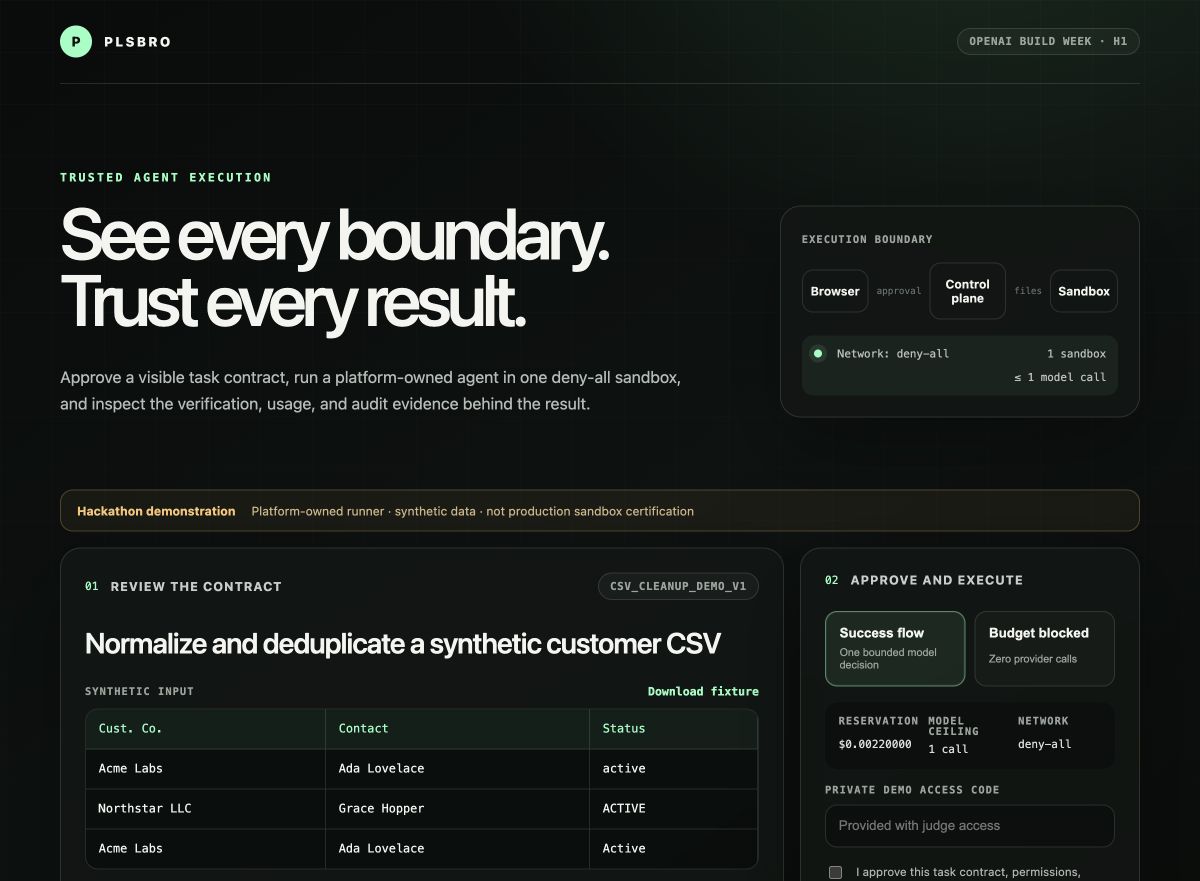
PLSBRO separates untrusted task execution from trusted model access and deterministic verification. The sandbox receives no OpenAI credential, has no public network access, and can only emit declared artifacts. The control plane owns the one bounded model decision and the audit evidence.
The OpenAI Build Week demonstration makes every boundary visible: a synthetic contract, explicit approval, two-stage runner, deterministic checks, measured usage, and an audit receipt. Simulated runs are labeled as simulated and cannot be represented as live evidence.
System map
From ambiguity to evidence.
- 01Specification
- 02Human approval
- 03Sandboxed execution
- 04Verification
- 05Audit receipt
Trust boundary
The agent cannot approve itself.
Developer logic proposes work inside a deny-all runtime. Platform code validates the request, enforces the privacy and cost envelope, and verifies the final files independently.
Economic boundary
Every paid action is attributable.
Provider usage is reserved before a call, measured afterward, and tied to the exact task and run. A budget-blocked mode makes zero provider calls and reports zero actual cost.
Product boundary
A demo of the operating layer, not a certification claim.
The public experience uses synthetic data and a platform-owned reference runner. It proves the control-plane pattern without presenting a hackathon prototype as an open marketplace or production certification system.